This website uses cookies to improve the website's function and also to enhance your user experience.By clicking 'Accept All", you consent to the use of cookies. To find out more, please read our cookies policy.
Before you purchase your dream lab diamond, it's important that you have a good understanding
of the properties of diamonds that determines their quality. To that end, we created this guide that breaks down all the complicated to simple explanations
and advice that will have you browsing diamonds with confidence. It all starts with the 4C’s. A diamond's brilliance, sparkle, quality, and value are all
defined by the 4C’s—Cut, Colour, Clarity, and Carat.
Carat
While carat and size might seem similar and interchangeable, they actually refer to different aspects of a diamond. Size refers to the dimensions of the stone and is measured in millimetres, while carat, NOT grams, specifies its weight.
We understand that the concept of carat can be confusing, so we’ll break it down to you with some examples. Imagine two diamonds, both weighing 1 carat. If the first diamond is cut very deep, it will appear smaller, closer in size to a typical 0.80-carat stone. On the other hand, if the second diamond is cut very shallow, it might look larger, more like a 1.25-carat stone, but this often comes at the expense of quality and diminished sparkle. Ideally, a well-cut 1-carat diamond will have both the size and sparkle that one expects from a 1-carat stone.
Improper cutting can prevent the diamond from achieving its full brilliance, often causing the centre to appear dark or lifeless. When diamonds are cut too deep or too shallow, their quality is compromised.
Clarity
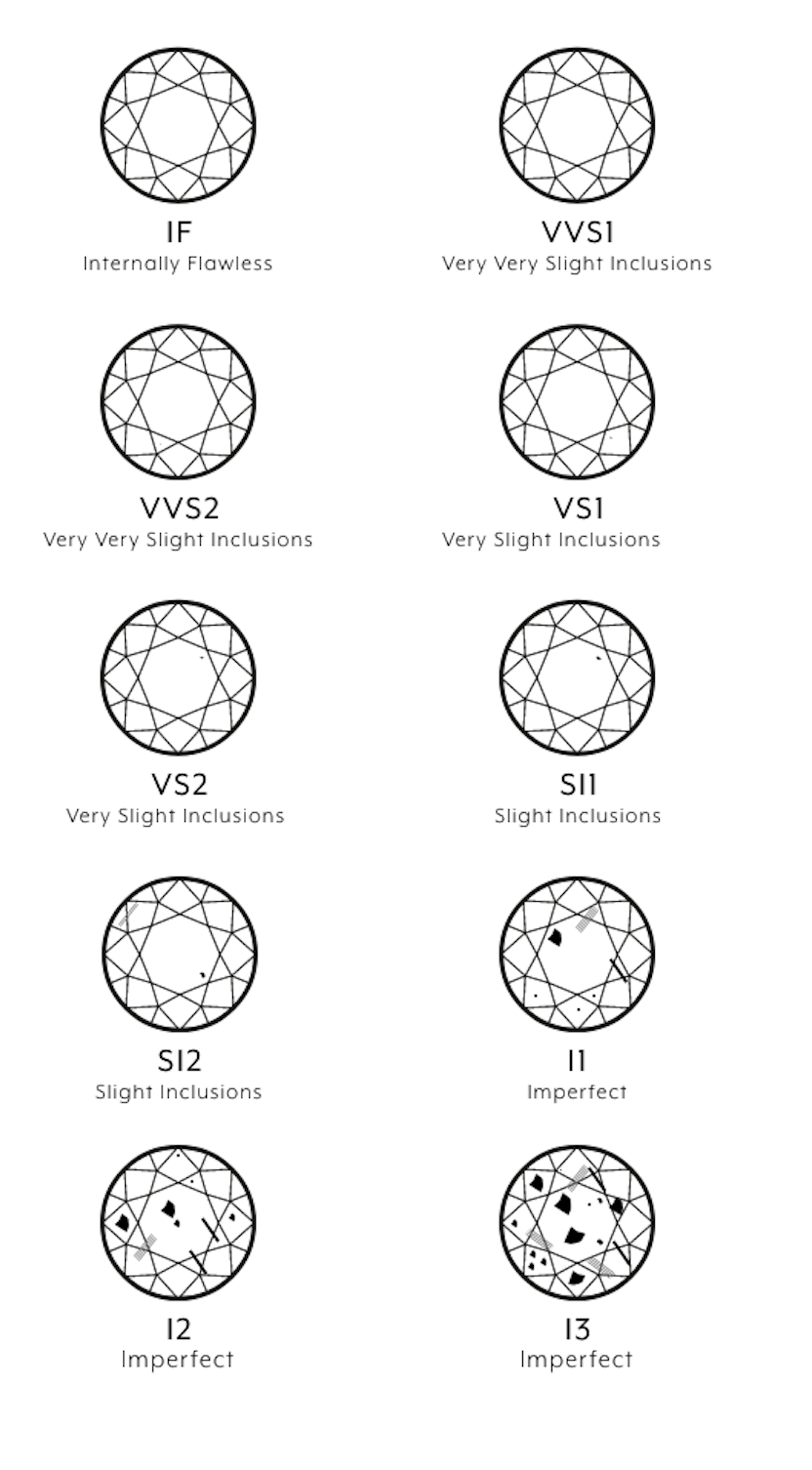
Clarity, one of the essential aspects of the 4 Cs, pertains to the 'clearness' of a diamond. Clarity grades indicate the number and visibility of imperfections (referred to as inclusions) within the stone. According to GIA, the clarity grades are as follows:
Flawless (FL), Internally Flawless (IF)
These represent the highest clarity grades a diamond can achieve. Flawless (FL) diamonds are completely free of visible inclusions when examined under 10x magnification. Internally Flawless (IF) diamonds are similar but may have some minor marks (blemishes) detectable under 10x magnification.
Very Very Slight Inclusions (VVS1 & VVS2)s
VVS1 and VVS2 comes next after FL and IF. Although they contain extremely small inclusions, these inclusions are almost impossible to detect, even for experienced gemmologists using 10x magnification. Examples of these inclusions may include pinpoints, needles, or internal graining.
Very Slight Inclusions (VS1 & VS2)
Still excellent clarity. Although lower in grade than VVS1 and VVS2, VS1 and VS2 grade diamonds are certainly eye-clean. VS1 and VS2 clarity diamonds have slightly larger inclusions than the VVS range which include crystals, cavities, or clouds. The inclusions are difficult to see in (VS1) but somewhat easier to spot in (VS2), but only if looked through 10x magnification.
Slight Inclusions (SI1 & SI2)
SI1 and SI2 diamonds have inclusions that are more much more noticeable under 10x magnification, and in some cases, can be faintly seen with the naked eye. These might include small feathers, knots, or chips.
Included (I1, I2 & I3)
I1, I2, and I3 are the lowest clarity grades, with inclusions that are easily visible to the naked eye and can affect the diamond's transparency and brilliance. These inclusions may include large crystals, extensive feathering, or other significant internal flaws, making these diamonds less popular for fine jewellery.
Novita's Recommendation:
At Novita Diamonds, we suggest choosing the highest clarity grade that fits within your budget. IF, VVS1, VVS2, VS1, VS2, to SI1 diamonds that are eye-clean, as in no visible inclusions with the naked eye. VS1 and VS2 are excellent if you want to strike a balance between cost and clear diamonds.
Clarity
Colour
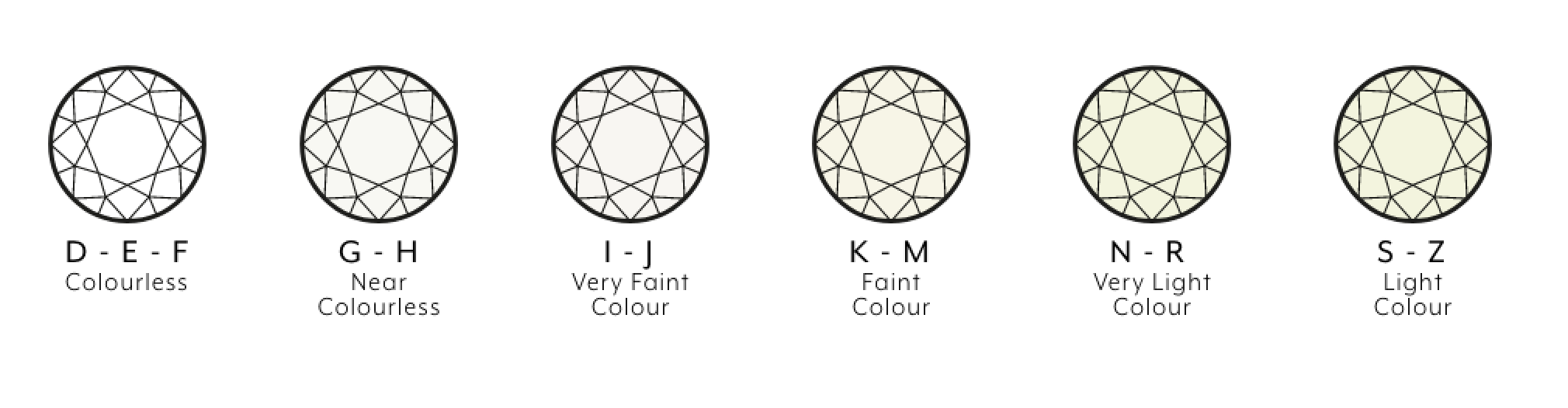
Of the 4 Cs, Colour is perhaps the simplest to understand. The Colour grade of a diamond refers to its lack of colour. The finest diamonds are completely colourless, which allows their natural brilliance to be on full display. Essentially, the whiter—or more transparent—a diamond is, the more valuable it becomes. As you move down the colour scale, faint hints of yellow or brown become more apparent, which can diminish the diamond's overall value. The GIA colour grading scale ranges from D (completely colourless) to Z (light yellow or brown). For easier classification, these grades are grouped into tiers, as even a one or two-grade difference can be challenging to notice without specialized training.
D,E,F (colourless)
D-F grade diamonds represent the highest level of colour grading and are among the rarest. These diamonds are completely colourless, meaning they have no visible yellow or brown tints, making them exceptionally clear and bright. D, E and F are grouped together since they are all considered "colourless" because, once set into jewellery, they appear identical to the naked eye. To accurately differentiate a D-colour diamond from an F-colour one, both diamonds need to be loose and compared side by side against a pure white background.
G,H (near colourless)
G-H grade diamonds are grouped together as "near colourless". While they do have a very faint hint of colour, this tint is difficult to notice with the naked eye. Once set in a piece of jewellery, these diamonds appear nearly white and can easily pass as colourless in most lighting conditions. Only when loose and directly compared to truly colourless diamonds can the slight difference be visible.
I,J (very faint Colour)
I-J grade diamonds are more common and considered of lower quality compared to higher colour grades like D-F and G-H. They are grouped together as having a very faint colour, with a slight yellow, brown, or grey tint that becomes more apparent when placed alongside diamonds from the colourless or near colourless categories. A colour grade below J will have deeper tint of yellow, brown, or grey hues, making them more noticeable.
Recommended by Novita:
Since D-F colour diamonds are all clear and colourless, they appear very similar to an untrained eye. Selecting a D-coloured diamond over an E or F grade often comes down to simple personal preference instead. If you choose a diamond with a colour grade of F or higher, you can put aside more of your budget towards improving other aspects of the diamond, such as its cut and shape.
On the other hand, G-H colour diamonds are a practical "budget stone" since they still appear mostly colourless and can provide considerable cost savings, allowing you to afford a larger stone than you might with a D-F colour diamond.
Recommendation: Going for diamonds with D-G Colour can save you money or help get a bigger stone.
Cut
The Cut grade might be the last but is the most crucial of the 4C’s. The Cut grade is central to what makes a diamond truly a diamond: the sparkle, fire, and brilliance depend completely on the quality of the Cut. A diamond that is not well-proportioned, being either too deep or too shallow, will allow light to escape from the bottom making it look lifeless. A properly proportioned and cut diamond should have all the light entering through the sides, or the facets, reflect upwards through internal reflection. This creates the brilliant sparkle, as the light reflects off each facet and returns upward to the eye, giving the diamond a radiant and almost magical look. Even a diamond of extremely high quality in every other category can still look dull and lifeless if the cut is compromised.
Recommended by Novita:
Never compromise on the cut grade and always go for a diamond that is either an Ideal Cut or an Excellent Cut.
Novita Diamonds Guidance:
Each of our lab grown diamonds in our showroom have been thoroughly inspected by our gemmologists
and only the top of each colour and clarity grade are kept for purchase by our customer. You can take full advantage of our gemmologists hard work by visiting
our showroom or purchasing from our site’s showroom selection. We still invite you visit our Singapore showroom and let our experts help you find the best
man made diamond engagement ring that matches your budget and preference for you or your loved one.
Note: When on our Novita website, you can easily filter diamonds to your liking by the diamond 4Cs category, as shown in the image below.
You can further filter the available diamonds in our showroom by clicking on the 'AVAILABLE IN SHOWROOM' tab and checking its availability in the 'SHOWROOM' column.
Remember the showroom mark also means the lab created diamonds have been individually inspected by our experts.
Lab Diamonds Singapore
Exceptional Value
FAQ'S
• Are lab grown diamonds real?
Undoubtedly, lab grown diamonds are genuine diamonds. They are created through the same chemical reactions
and physical processes that occur naturally within the Earth, but in a controlled laboratory environment.
This process involves the gradual accumulation of carbon atoms around a diamond crystal, increasing its size.
Lab made diamonds are chemically, physically, and optically identical to natural diamonds, thus scientifically
recognized as real diamonds. Both IGI and GIA, the leading authorities on diamonds, grade lab diamonds using
the same scale and methodologies as mined diamonds. For more information, you can explore our
about lab diamonds page.
• How much cheaper are lab diamonds?
Lab grown diamonds are considerably more affordable
than mined diamonds. The price difference varies depending on factors such as size, quality, and type,
but typically, lab made diamonds are about 75% less expensive than natural diamonds. The reason
for this is that the cost of producing rough laboratory grown diamonds is much lower than that of mining
and removing rough natural diamonds from the earth. However, to become retail-ready, a rough diamond must
go through all the same processes, including cutting, polishing, and certification, regardless if it is
mined or lab grown diamonds; they undergo the same processes.
To point up the significant savings you can expect, consider this example: If a mined diamond costs S$ 10,000,
a comparable lab grown diamond would only cost around S$ 2,500. This price difference highlights how buying a
lab grown diamond over a mined one can be done without braking the bank.
• Do lab diamonds test as diamonds?
Yes they do when being tested with a diamond tester. All lab grown diamonds are tested using the same methods as natural diamonds;
there are no differences between two. Diamonds, whether they are mined or made, possess a variety of unique properties, including hardness,
refractive index, and thermal conductivity. Lab made diamonds are chemically, physically, and optically identical to natural diamonds,
so they will exhibit the same properties and characteristics when tested.
• Do lab grown diamonds have inclusions?
Just as in natural diamonds, inclusions are also present in most lab diamonds. Inclusions are natural imperfections
that are found within diamonds, and they can occur in both lab and natural diamonds. Inclusions can take many forms,
such as tiny bubbles or carbon deposits trapped inside the diamond as it formed. Just like natural diamonds, most
diamonds created in labs have flaws, and only very few become flawless. Check out our guide to the
4Cs for more
information about diamond clarity.
• Can I insure lab grown diamond rings?
Yes insurers will insure lab made diamond rings the same way they would mined diamond rings, because are treated exactly
the same as mined diamonds. When you visit us you can ask our team for guidance they will be happy to assist you. Keep
in mind, your insurance policy will typically cover the cost of replacing or repairing your item if it is lost, stolen,
or damaged. Make sure you read the terms of your insurance policy carefully, so you know what it covers and what it does
not.
Thank you for requesting an appointment at Novita Diamonds.
Your request has been noted and you will be contacted shortly by one of our friendly staff to finalise your appointment.
If you require an urgent appointment, please call our office on 6980 8200.



 |
10500+ 5 Star Reviews
|
10500+ 5 Star Reviews  |
Quality Guaranteed
|
Quality Guaranteed 
 IN-STORE
  VIRTUAL


 AUD
AUD
 NZD
NZD
 USD
USD
 GBP
GBP
 EUR
EUR
 SGD
SGD
 CAD
CAD
 HKD
HKD
 JPY
JPY
 +65 8139 6883

 SALE
SALE
 Start With a Diamond
 Start With a Ring Design
 Solitaire
 Sidestones
 Halo
Halo Three Stone
 Toi ET Moi
 Vintage
 Hidden Halo
 Classic
 Unique
 Pave
Pave Round
Round Pear
Pear Oval
Oval Emerald
 Cushion
 Princess
 Radiant
 Asscher
 Marquise
 Platinum
 18ct White Gold
 18ct Rose Gold
 18ct Yellow Gold


 Sapphire
 Ruby
Ruby Emerald
 Moissanite
 Alexandrite
 Cushion – Elongated